Lake Alaotra Rice: Inside Madagascar's Rice Bowl
Lake Alaotra rice explained: Madagascar's largest lake, the PC15 and PC23 irrigation schemes, Amparafaravola, the rice calendar, the bandro lemur and threats.
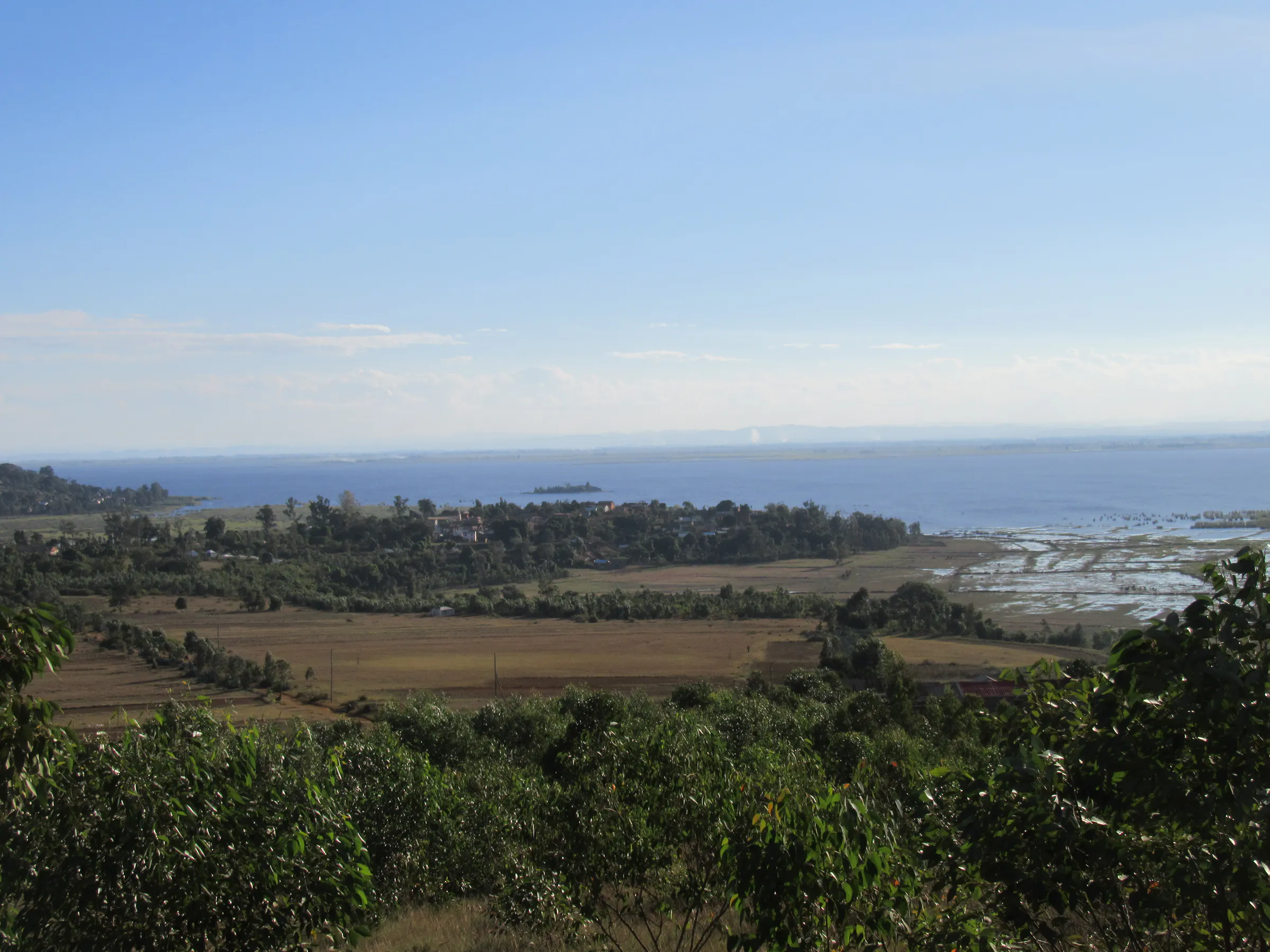
From the air, Lake Alaotra looks like a dark sheet of water framed by a vast green and gold chequerboard. Those squares are rice paddies, around 100,000 hectares of them, surrounding Madagascar’s largest lake. Malagasy people have long called this basin the island’s granary, and in English it is often described as Madagascar’s rice bowl. Alaotra rice, and above all the long-grain Makalioka variety, comes from here, in the Alaotra-Mangoro region. This guide covers the geography, the history of the irrigation schemes, the farming calendar, the wildlife and the pressures facing Lake Alaotra rice.
Lake Alaotra: geography of Madagascar’s largest lake
A shallow basin at 750 metres
Lake Alaotra fills a depression in Madagascar’s eastern highlands at about 750 metres above sea level, less than 200 km north-east of Antananarivo as the crow flies. It is remarkably shallow: about 0.6 metres deep on average and 1.5 metres at most, according to Wikipedia. Its size swings with the seasons. Published figures range from roughly 200 to 900 km², depending on whether they count open water alone or include the marshes and reed beds around it.
Rivers such as the Sahabe, Sasomanga, Sahamaloto and Anony feed the lake from the surrounding hills, and the Maningory carries its water down the eastern escarpment to the Indian Ocean (Ramsar).
Ambatondrazaka and Amparafaravola
The basin is split between two districts. Ambatondrazaka, to the south and east of the lake, is the regional capital and the trading hub, home to rice mills and grain collectors. To the west lies Amparafaravola District: 4,623 km² and about 338,000 people in 2020, more than 80% of whom farm, with rice as the main crop (Wikipedia). The town of Amparafaravola is about 65 km from Ambatondrazaka on National Road 3a. Amparafaravola rice comes from this western shore, an area of large irrigation schemes and alluvial plains planted with long-grain varieties.
How the rice bowl was built
The Sihanaka, people of the marshes
Long before the canals, this was Sihanaka country. Their name is usually translated as “people of the swamps” (Wikipedia). They fished, grew rice and herded zebu cattle, and by the 1600s they were trading along the route between the east coast and the highland kingdom of Imerina. The Merina conquered the region around 1800. In the 20th century, new farmland drew Merina and Betsileo migrants from the highlands, so today’s population is mixed, although Sihanaka elders still oversee many local rules (Géoconfluences).
From colonial schemes to SOMALAC
Large-scale development began between the two world wars. The French colonial administration divided the plain into numbered “colonisation perimeters”, which is why the main schemes are still called PC15 and PC23. Dams and drainage canals turned marsh into paddy. In the first half of the 20th century (sources disagree on the exact year), the lake’s agronomic station selected Makalioka 34 (Patrice Garin and Éric Penot), later disseminated more widely by IRAM from the 1950s: the variety that made Alaotra rice famous (see our guide to Makalioka rice).
After independence, the state-owned SOMALAC (Société malgache d’aménagement du lac Alaotra) ran the schemes from 1961 to 1991. It completed the three main perimeters, PC15, PC23 and PC Nord, which cover close to 30,000 hectares, with work finished in 1974 according to a JICA report. When the state pulled out in 1991, water management passed gradually to farmers’ water user associations.
The irrigation schemes: PC15, Vallée Marianina and PC23
PC15 and Vallée Marianina. This scheme lies on the edge of Ambatondrazaka, in the communes of Ambohitsilaozana and Ambatondrazaka, and is fed by the Beava dam. Sources give its area as anywhere from 2,800 to about 4,000 hectares depending on what is included. Researchers at Lyon 3 University report some of the highest yields in Madagascar there, around 4 tonnes of paddy per hectare (Erismann, HAL).
PC23, on the Amparafaravola side. PC23 covers the south-west of the basin, straddling Amparafaravola and Ambatondrazaka districts. Its main canal, P1, draws on the Sahabe and Sahamilahy rivers. JICA puts its net irrigable area at 9,870 hectares, only part of which gets a reliable water supply. Makalioka 34, with a growing cycle of about 180 days, is the main variety grown (JICA). On the lake’s western edge, the Sahamaloto reservoir, built around 1955, irrigates another major scheme.
Three kinds of rice land
CIRAD agronomists describe three main farming environments (Géoconfluences):
- Irrigated paddies in the large schemes and traditional networks: about 30,800 hectares in 2010.
- Paddies with poor water control, known locally as RMME: about 70,000 hectares in 2009. Their yields depend directly on rainfall.
- Baiboho and tanety: footslopes and hills, planted with upland rice, maize, cassava and legumes.
Average irrigated yields are about 2.5 tonnes of paddy per hectare, rising to 4.5 tonnes in the best schemes.
How much rice does Alaotra produce?
The basin is often credited with about 200,000 tonnes of milled rice a year and a marketable surplus of around 80,000 tonnes (Wikipedia FR). JICA estimates the basin meets about 10% of national annual demand. Estimates vary by year and source, but all agree that this is one of the few regions of Madagascar with a large, regular surplus. Lorries from the lake supply Antananarivo and Toamasina, and “rice from the lake” is a selling point in Malagasy markets. To see where Makalioka sits among the island’s other rices, read our guide to Madagascar rice varieties.
The Lake Alaotra rice calendar
- October to December: paddies are ploughed with zebu or power tillers and nurseries are sown.
- December to February: seedlings are transplanted at the height of the rainy season.
- March: the crop grows; fields are weeded and water levels managed.
- April to June: harvest, threshing and sun-drying.
- July to September: dry season; milling, sales, and zebu grazing on the stubble.
Long-cycle varieties like Makalioka allow one main harvest a year. Fishing, busiest from May to October, adds income for many lakeside households.
The bandro and a Ramsar wetland
On 9 September 2003, Lake Alaotra and its catchments, 722,500 hectares in all, were listed as a Wetland of International Importance under the Ramsar Convention (Ramsar). The listing protects in particular the reed beds where the Alaotra gentle lemur, or bandro (Hapalemur alaotrensis), lives. It is the only primate on Earth that lives exclusively in reed beds.
The bandro is Critically Endangered. Its numbers fell by about 80% after the 1990s, to an estimated 2,000 to 2,500 animals in 2015 (Mongabay). Durrell Wildlife Conservation Trust and Madagascar Wildlife Conservation, which runs Park Bandro, work with village associations that manage the marsh. The lake has already lost one species: the Alaotra grebe was declared extinct in 2010 (Wikipedia).
The pressures: erosion, sand and water
The hills around the basin are scarred by lavaka, huge amphitheatre-shaped gullies. Bush fires, overgrazing and deforestation speed them up. Each rainy season, sand from the hills washes down onto the paddies and clogs irrigation and drainage canals, shrinking the farmed area, lowering fertility and raising maintenance costs (Madonline).
Sediment also settles in the lake, which is now only about 60 cm deep in the dry season. Less stored water means fewer fish, harsher floods and less reliable irrigation late in the season. Marsh fires, lit to fish or to clear new paddies, eat further into the reed beds.
Several programmes have tried to reverse the trend. The BV-Lac project (2003–2013), funded largely by the French development agency AFD, promoted conservation agriculture on the hills (Géoconfluences), and JICA has backed rehabilitation of PC23 and its watersheds. The logic is simple: protect the hills to keep the paddies below them productive.
Makalioka from Amparafaravola, field to bag
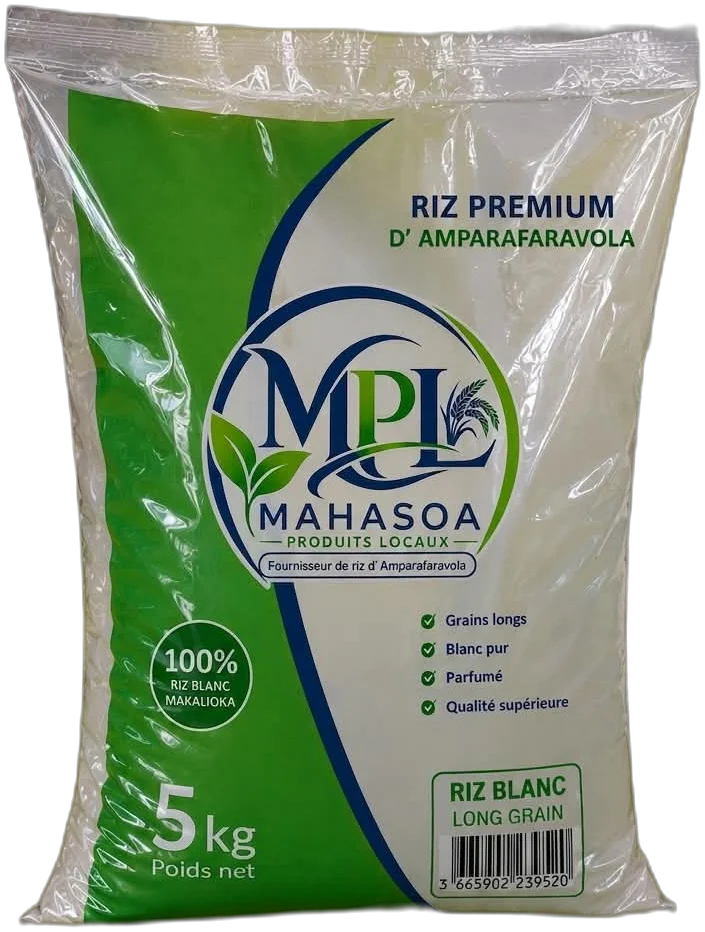
This is the land behind Makalioka Premium white rice, 5 kg, from MAHASOA PRODUITS LOCAUX: 100% Makalioka white rice, long grains, pure white and fragrant, grown in Amparafaravola and selected and packed to deliver a clean, superior-quality product. For tips on choosing a good bag of rice from the lake, see our guide on how to buy Malagasy rice, or see our rice on the home page.
Order rice from Lake Alaotra
Are you a retailer, grocer or home cook looking for Makalioka rice from Amparafaravola? Contact us by phone or WhatsApp on +261 38 51 783 94, or visit our home page.
Frequently asked questions
Why is Lake Alaotra called Madagascar's rice bowl?
By CIRAD estimates, the basin around Lake Alaotra holds roughly 100,000 hectares of paddies, irrigated or rain-dependent: the largest rice plain in the country. It produces far more than local households eat, and its surplus supplies Antananarivo and Toamasina. A JICA study puts the basin's contribution at about 10% of Madagascar's annual rice demand, which is why Malagasy people call it the island's granary.
Where is Lake Alaotra?
Lake Alaotra lies in the Alaotra-Mangoro region, north-east of Antananarivo, at about 750 metres above sea level. The lake sits in a basin ringed by hills, between the districts of Ambatondrazaka and Amparafaravola. It drains towards the Indian Ocean through the Maningory River.
When is rice harvested at Lake Alaotra?
The main season follows the rains. Farmers sow nurseries from October to December, transplant seedlings from December to February and harvest from April to June. Long-cycle varieties such as Makalioka 34 need about six months in the field, so most paddies give a single main harvest each year.
What is the Alaotra gentle lemur?
The Alaotra gentle lemur (Hapalemur alaotrensis), called bandro locally, is a small lemur found only in the reed beds and papyrus marshes of Lake Alaotra. It is the only primate in the world that lives exclusively in wetlands. It is listed as Critically Endangered, threatened by marsh burning and the spread of rice fields.