Madagascar Rice Varieties: Types of Malagasy Rice Explained
Makalioka, tsipala, vary gasy, red rice, upland rice and X265: a guide to Madagascar rice varieties, their grains, growing regions and uses in the kitchen.
Walk through a rice market in Antananarivo or Mahajanga and you will not find one “Madagascar rice” but dozens: long and round, white and red, irrigated and rain-fed, local and imported, each with its own name and price. The 2001 commune census alone recorded 773 rice names across the island, and FOFIFA, the national agricultural research centre, keeps thousands of accessions in its collections at Lake Alaotra and Marovoay. This guide sorts out the main types of Malagasy rice, from the most prized to the most everyday.
How Malagasy rice is classified
The market view: vary gasy, tsipala, makalioka, imported
A study by IDE-JETRO for JICA’s PAPRIZ project, based on nearly 12,000 price records from 31 markets, found that traders use four categories: vary gasy, tsipala, makalioka and importé. Vary gasy made up about 68% of observations. Makalioka was significantly more expensive than common local rice, while tsipala and imported rice were not. Across the country, white rice and long-grain rice also fetched higher prices on average, though in some zones red rice was the dearer option.
The cook’s view: long, round, medium and upland
Households think in terms of grain shape and growing method. A CIRAD-supervised study of rice consumption in Antsirabe describes four families within vary gasy: vary lava (long), vary botra (round), vary antonony (medium, led by rojo, “necklace” rice, named for its bead-like panicle) and vary tanety (upland rice grown on hillsides).
Makalioka: the benchmark long-grain rice
Makalioka is the signature rice of Lake Alaotra in the Alaotra-Mangoro region. According to Patrice Garin and Éric Penot (2011), the Makalioka 34 line comes from the Lake Alaotra agronomic station, where it was selected in the first half of the 20th century (sources disagree on the exact year). The Madagascar Agronomic Research Institute (IRAM) later disseminated it, around the 1950s, alongside Ali Combo, Rojofotsy 1285 and Vary lava 16, according to Jean-Claude Randrianarisoa’s study of variety adoption. He describes it as impossible to dislodge at Lake Alaotra: close to 88% of the area’s communes still named it their main variety, despite newer lines such as 2798, 2787 and Tsemaka, a Makalioka × 2798 cross.
Its grains are long, slender and translucent. Antsirabe shoppers class it as luxury rice, usually sold in 1 kg or 5 kg packs rather than loose; Madrigal is parboiled Makalioka. In cities it is often simply called Alaotra rice. Read more in our Makalioka rice guide and in Lake Alaotra, Madagascar’s rice granary.
Tsipala: one name, many grains
Tsipala is one of the most widespread rice names in Madagascar: in the early 2000s it ranked among the top three varieties in 292 communes. It is not a single variety, though, but a market name covering several rices. In Antsirabe the word means long-grain rice in general, while the IDE-JETRO market study describes it as shorter and rounder than makalioka: the same name can mean a different grain from one region to the next. Tsipala is common in the northwest (Marovoay, Mahajanga, Sofia) and in city markets, and during the lean season it is also ground into flour for mofo gasy.
Vary gasy: the great family of local rice
Vary gasy means “Malagasy rice” and is defined first against imported rice, which consumers tend to find drier and less flavourful. The IDE-JETRO survey counted 259 market names under this label, covering round, medium, red and long rices.
That diversity runs deep. Research by Nourollah Ahmadi and colleagues (FOFIFA, CIRAD), published in Rice in 2021, analysed 620 Malagasy landraces and identified a group found only in Madagascar, called “Gasy”, making up 36% of the panel. These are lowland rices grown mainly between 800 and 1,600 m, with shorter, wider grains than indica. The authors link the group to crossing between indica-aus and japonica types in the highlands, and to the later Austronesian arrivals who developed lowland paddy farming there.
Vary mena: Madagascar red rice
Vary mena owes its colour to the bran layer, and comes in many local forms: rojomena, botra kely mena, angika mena. Light milling keeps the red; heavy polishing removes it. In Antsirabe, red and hand-pounded rice are prized for a sweet taste in vary sosoa, the soft breakfast rice cooked in plenty of water, but very red rice is seen as slow to cook, so markets often sell a white-red blend.
There are improved red rices too. AfricaRice and FOFIFA released FOFIFA 194, 195 and 196 (the last also known as Vaniala), described as high-yielding, early, blast-resistant and cold-tolerant, with more zinc, iron and magnesium than local checks. They are being demonstrated in Vakinankaratra, Analamanga and Itasy.
Upland rice and tavy rice
Not all Malagasy rice grows in flooded paddies. Vary tanety (vary an-tanety, hillside rice) is rain-fed, grown mostly in the Middle West and increasingly on the highlands. Harvested in March and April, ahead of irrigated rice, it reaches markets at the end of the lean season and is often the cheapest rice of the moment.
For high altitudes, FOFIFA and CIRAD bred a set of upland varieties listed in the catalogue for the highlands from 1,300 to 1,800 m, including FOFIFA 161, 167, 168, 172 and the Nepalese Chhomrong Dhan. Flexible SEBOTA-type varieties of Brazilian origin can be grown rain-fed or transplanted, useful in poorly irrigated areas of Lake Alaotra and Vakinankaratra.
On the east coast, upland rice is traditionally tied to tavy (called hatsake in the southeast), slash-and-burn farming where rice is sown in the ashes for two or three seasons, a practice widely debated as a driver of deforestation.
Improved varieties: X series, IR, FOFIFA and Mavitrika
Since the 1980s FOFIFA has introduced varieties from IRRI, IRAT, China, Indonesia and Japan. IR8, IR16 and IR20 took hold in the northwest, where over 58% of communes in the Mahajanga region listed them among their main varieties in 2001. The X series, notably X265 and X360, spread in Marovoay (over 40% of communes), Sofia and Haute Matsiatra. X265 is described as the recommended variety for the central highlands in zinc trials, and farmer groups in Itasy promote it for holding up when rain is short.
The newest notable release is Mavitrika, approved on 21 March 2024. Developed by JIRCAS, the University of Bonn, AfricaRice and FOFIFA, it is the first zinc-biofortified rice approved in Madagascar, selected directly in farmers’ fields for better phosphorus uptake on poor soils.
Madagascar rice varieties at a glance
| Variety or name | Grain type | Main region | Typical use |
|---|---|---|---|
| Makalioka (Makalioka 34, Tsemaka) | Long, slender, translucent | Lake Alaotra (Alaotra-Mangoro) | Premium white table rice, vary maina, festive meals |
| Tsipala | Mixed label, often long grain | Island-wide, especially northwest | Everyday rice, flour for mofo gasy |
| Vary gasy (category) | Long or round, white or red | Island-wide | Everyday local rice |
| Vary botra | Round | Highlands (Antsirabe, Imerina) | Daily meals, vary sosoa |
| Rojo (vary antonony) | Medium | Imerina, Itasy, Vakinankaratra | Everyday highland rice |
| Vary mena (rojomena, FOFIFA 194-196) | Round or medium, red bran | Highlands, Amoron’i Mania, Haute Matsiatra | Vary sosoa, valued for sweet taste |
| Vary tanety (FOFIFA 161, 172, SEBOTA) | Varies; often round or medium at altitude | Middle West, Vakinankaratra | Early-season rice, home consumption |
| Tavy rice | Local upland varieties | East coast | Household consumption |
| X series and IR series | Improved, grain varies | Marovoay, Sofia, Haute Matsiatra, Itasy | Everyday rice sold as vary gasy |
| Mavitrika | Improved, high zinc | Low-phosphorus highland soils | Everyday rice with added nutrition |
| Imported rice | Mostly long | Cities and ports | Low-cost lean-season rice |
Choosing a Malagasy rice for the dish
For vary maina, dry rice with separate grains served with romazava or ravitoto, a long grain such as Makalioka gives a clean, fragrant result. For morning vary sosoa, many families reach for round or red rice, which releases more starch and that sweet note. See how to cook Malagasy rice for water ratios and where to buy Malagasy rice for spotting well-sorted grain. It matters: the average Malagasy eats about 153.5 kg of rice a year, more than half of daily calories, according to FAOSTAT data (2022 estimate) cited by the IMF.
Makalioka Premium from Amparafaravola
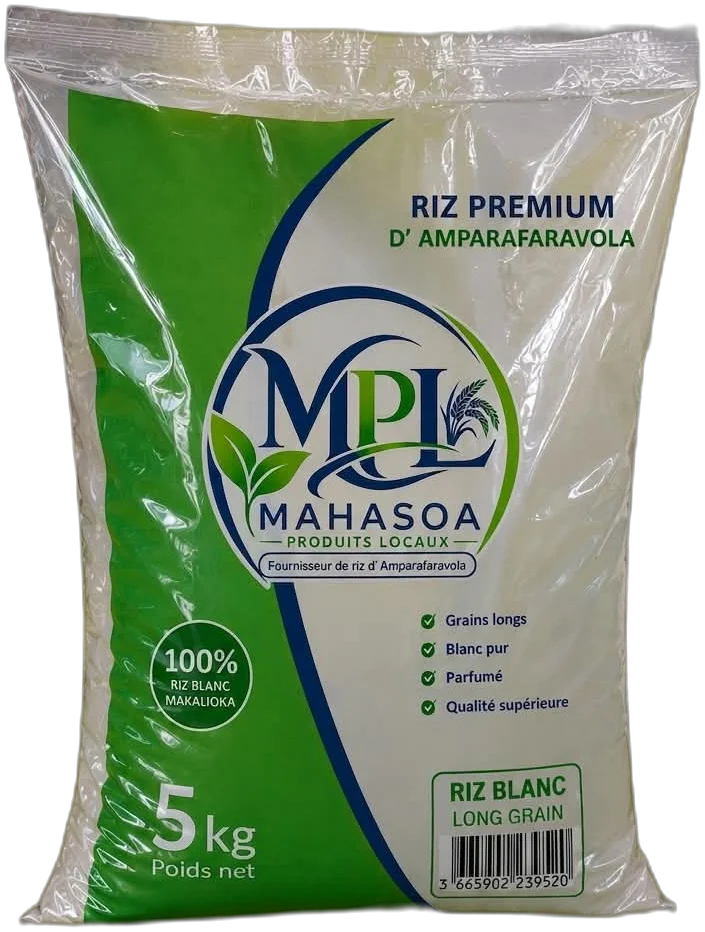
MAHASOA PRODUITS LOCAUX selects and packs a 100% Makalioka white rice from Amparafaravola, in the heart of Alaotra-Mangoro: long grains, pure white, fragrant, in a 5 kg bag. See Makalioka Premium white rice on our home page.
Order Makalioka rice
Retailer, grocer or home cook looking for top-quality Madagascar rice? Call +261 38 51 783 94 or contact us to check availability.
Frequently asked questions
What are the main types of rice in Madagascar?
Malagasy markets sort rice into four broad categories: vary gasy (any local rice that is not tsipala or makalioka), tsipala, makalioka and imported rice. Within those labels sit hundreds of local and improved varieties: round rice (vary botra), medium rice (rojo), red rice (vary mena), upland rice (vary tanety) and improved lines such as X265 and the FOFIFA series.
What is the best rice in Madagascar?
Makalioka from Lake Alaotra is widely regarded as the country's premium rice, with long, slender, translucent grains. A price study across 31 markets found it sells for significantly more than ordinary local rice. Many highland families still prefer a local red or round rice for its taste, so the best choice depends on the dish.
What does vary gasy mean?
Vary gasy literally means Malagasy rice. In trade it covers any locally grown rice outside the tsipala and makalioka labels, as opposed to imported rice. It is a very mixed category: one market survey recorded 259 different names under it, with long and round grains, white and red alike.
Is Malagasy red rice a single variety?
No. Vary mena is a family of rices with a red bran layer, sold under names like rojomena, botra kely mena or angika mena. Lighter milling keeps more of the colour. FOFIFA and AfricaRice have also released improved red rices, FOFIFA 194, 195 and 196, with higher zinc and iron content than local check varieties.